Why Your Salary Runs Out Before Month-End: A 5-Step Personal Finance Plan for Tanzanians
It usually isn't because you earn too little. It's because nobody ever gave you a system. Here is a simple one, built for real Tanzanian life: family, michango, M-Pesa and all.
Payday arrives on the 25th. By the 5th, rent, bills and loan deductions are gone. By the 15th, you are counting coins. By the 20th, the phone is asking whether you'd like a quick loan, and you say yes, again. Then payday comes, the loan is deducted, and the cycle starts over.
If that sounds familiar, please hear this first: you are not bad with money. Most of us were never taught how to manage it. We learned from watching our parents, from friends, and from our own painful mistakes. What you're missing isn't a bigger salary. It's a system.
In this article I'll show you a simple five-step plan, and we'll watch one family use it to close a gap that had been swallowing them every month.
Meet Baraka and Rehema. Baraka is a logistics clerk in Dar es Salaam on a gross salary of TSh 1,200,000 (TSh 928,000 after NSSF and PAYE). Rehema runs a tailoring stall in Mbezi that makes about TSh 450,000 a month. Together: TSh 1,378,000. Yet every month ended about TSh 207,000 short, and a digital loan filled the hole. (They're fictional, but their numbers are built from real costs.)

Step 1: Find Out Where the Money Really Goes

Most people know what they earn. Very few know where it goes. For the next 30 days, write down every shilling: the bajaji, the airtime, the chips on the way home. Your M-Pesa, Mixx, Airtel Money or bank statement will show most of it; a small notebook catches the cash.
At the end of the month, group your spending. Almost everyone discovers two or three "leaks" they never noticed: daily snacks, data bundles, fees from many small transfers, weekend outings. Baraka and Rehema found they were spending TSh 80,000 a month eating out and TSh 40,000 on airtime, money that had simply vanished.
While you're at it, calculate your net worth: everything you own minus everything you owe. Baraka and Rehema were surprised to find theirs was positive (about TSh 7.5 million, mostly a plot in Kibaha). Their problem wasn't wealth. It was cash flow.
Step 2: Build a Budget That Plans for Real Life
Many budgets fail because they're built for a life nobody lives. They forget the cousin's hospital bill, the wedding committee and the slow month in the shop. The well-known 50/30/20 rule was designed for countries where few people support relatives. In Tanzania, family obligations are a real expense, so give them their own line:
| Share | Category | Covers |
|---|---|---|
| 50% | Needs | Rent, food, school fees, transport, utilities, minimum loan repayments |
| 20% | Future you | Emergency fund, savings goals, extra debt repayment, investing, VICOBA or SACCOS |
| 20% | Wants | Clothes, eating out, entertainment |
| 10% | Family and community | Support for parents and relatives, michango, giving |
Two habits make this work. First, give family support a fixed monthly amount, tell your close relatives kindly what you can do, and stick to it. Second, if you run a business, separate business money from personal money and pay yourself a fixed salary from the business. Mixing them is the fastest way to eat your capital.

Here's what one honest evening with the numbers did for Baraka and Rehema:
| Where they cut | Before | After |
|---|---|---|
| Food (bulk buying, meal plan) | 400,000 | 330,000 |
| Eating out and fun | 80,000 | 20,000 |
| Family support (now a fixed amount) | 100,000 | 70,000 |
| Michango and events (capped) | 60,000 | 30,000 |
| Airtime, clothes, transport, utilities | 250,000 | 195,000 |
| Rent, school, loans, VICOBA (unchanged) | 695,000 | 695,000 |
| Emergency fund (new) | 0 | 38,000 |
| Total vs income of 1,378,000 | 1,585,000 | 1,378,000 |
The TSh 207,000 gap closed, and for the first time, money started flowing to their future. It wasn't much. It was the beginning.
Step 3: Build Your Shield, an Emergency Fund

Without savings, every emergency becomes a loan: a child's hospital bill, a sudden funeral, a broken motorbike. An emergency fund breaks that cycle. Start with one month of essential costs (rent, food, school fees, transport, utilities, minimum loan payments). Then build to three months on a steady salary, or six if your income is irregular.
Keep it safe, separate and reachable within a day or two: a savings account without a debit card, or a money market unit trust. Not in land, livestock, shop stock or a loan to a relative.
Is your money safe in the bank? Deposits at banks licensed by the Bank of Tanzania are protected by the Deposit Insurance Board, currently up to TSh 7,500,000 per depositor per bank.
Baraka and Rehema's starter goal was TSh 1,150,000. With TSh 38,000 a month, part of their December VICOBA share-out, and the furniture payment redirected once it ended, they passed it within 12 months.
Step 4: Get Out of Debt, Then Stay Out

Not all debt is bad. A fair loan for equipment that raises your profit can be smart. But debt for things that are already gone, like last month's food, keeps you poor. Three rules protect you:
- The one-third rule. Keep all loan repayments below one third of your take-home pay, ideally below a quarter.
- Always ask: "How much will I pay back in total?" And ask whether interest is flat or on the reducing balance. A flat rate of 15% costs about the same as a reducing rate of 27%. (I explain this trap in detail in 4 Ways Banks Drain Your Money.)
- Borrow only from licensed lenders. Check the Bank of Tanzania's list before using any app, and never hand your title deed, ATM card or PIN to an informal lender.
To clear debt, list every loan, pay the minimum on all of them, and attack one at a time: the highest interest first (the "avalanche", which saves the most) or the smallest balance first (the "snowball", for quick wins). When one is gone, roll its payment into the next.
Baraka and Rehema cleared the digital loan in week one from savings and deleted the app. They called the friend they owed, apologised, and agreed to repay him from the VICOBA share-out. Their remaining repayments came to about 21% of income, safely inside the one-third rule.
One more thing: your repayment record now follows you. Tanzania's two licensed credit bureaus, Creditinfo and Dun & Bradstreet, keep your history, and you're entitled to one free credit report a year. Check yours.
Step 5: Make Your Money Work for You
Once you have an emergency fund and no expensive debt, start investing, even a little. Time is the magic ingredient. If you invest TSh 100,000 a month at an average of 10% a year:
| After | You put in | It grows to about |
|---|---|---|
| 10 years | TSh 12,000,000 | TSh 20,480,000 |
| 20 years | TSh 24,000,000 | TSh 75,940,000 |
(An illustration, not a promise: real returns rise and fall.) Tanzanians have good, accessible options: unit trusts such as UTT AMIS funds that accept small amounts, Treasury bills (minimum bid TSh 500,000), Treasury bonds (minimum bid TSh 1,000,000, paying interest twice a year), and shares on the DSE. Match each to how soon you'll need the money, and don't keep everything in land: you can't sell a corner of a plot to pay school fees.
Walk away from any "investment" that promises guaranteed high returns, pays you for recruiting others, pressures you to decide today, or runs "forex" or crypto trading through WhatsApp groups. Check that investment firms are licensed by the CMSA.
One Year Later
No digital loans for eleven months. The friend repaid. Furniture paid off. An emergency fund of over TSh 1.2 million. A children's education fund growing every month. The salary loan on track to be cleared in year two. Same incomes. A completely different life.
📘 Get the Complete Guide, with 11 Ready-to-Use Tools
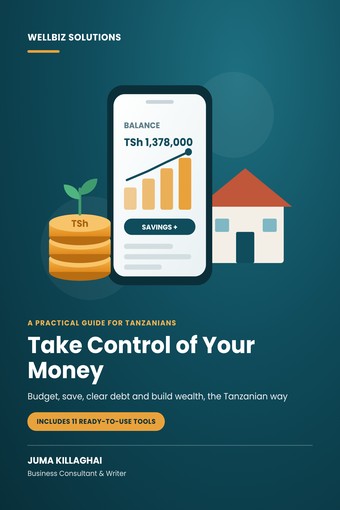
This article gives you the five steps. Take Control of Your Money walks you through every part of your financial life in 15 practical chapters: budgeting, cash flow, emergency funds, banking and VICOBA, debt, your credit record, investing in Tanzania, NSSF/PSSSF and retirement, PAYE, insurance, wills, and a 12-month action plan, with Baraka and Rehema's full story.
Plus 11 tools: an Excel Personal Finance Planner with 9 linked sheets (net worth, monthly budget, expense tracker, debt plan, savings goals, salary and PAYE calculator, investment growth and retirement planner) and 10 editable Word tools, from a goals worksheet to a will preparation worksheet.
How to get your copy:
- Click payhip.com/b/Peasp
- Tap "Buy Now" and complete checkout
- Download the PDF guide, the Excel planner and the 10 Word tools instantly
One digital loan you never take again pays for it.
👉 Get the guide and the 11 tools
Prefer Kiswahili? Get the Kiswahili edition: Shika Hatamu ya Pesa Zako
Frequently Asked Questions
How should I divide my salary each month?
A practical starting point is 50-20-20-10: about 50% for needs, 20% for your future, 20% for wants and 10% for family and community. Adjust it to your life, but always give something to your future.
How big should my emergency fund be?
Start with one month of essential costs, then build to three months on a steady salary, or six months if your income is irregular or you run a business.
How much of my income can safely go to loan repayments?
Keep all repayments below one third of your take-home income, and ideally below a quarter.
Is my money safe in a Tanzanian bank?
Deposits at banks licensed by the Bank of Tanzania are protected by the Deposit Insurance Board, currently up to TSh 7,500,000 per depositor per bank.
Where can I get a personal finance guide and budget planner made for Tanzania?
Take Control of Your Money comes with an Excel Personal Finance Planner and 10 editable Word tools. It is available on Payhip in English and Kiswahili.
Final Word
You will slip. Some months the budget will break and an emergency will eat your savings. That's normal. What matters is coming back to the plan the next month. Start with Step 1 today: just write down what you spend. Your future self is waiting to thank you.
Want help with your family or staff finances? Wellbiz Solutions offers one-to-one money coaching and financial literacy workshops for staff, SACCOS and VICOBA groups. Call or WhatsApp: +255 754 281 131 / +255 655 281 131
Found this helpful? Share it with someone who always runs out of money before payday.
This article is for education and is not personal financial advice. Figures were checked in October 2026.
Join the conversation