Where to Find Funding for Your NGO in 2026: International Donors That Still Fund Local Organisations
USAID is gone and Europe is cutting aid. Many local NGOs and community groups lost their main donor almost overnight. The money has not disappeared. It has moved, and it is harder to find. Here is where to look.

If you run an NGO, a CBO or a faith-based project, 2025 was probably the hardest funding year you have ever had. Projects stopped mid-way. Staff were let go. Proposals that once had a good chance came back with a polite "no".
The good news is that international funding for civil society has not ended. The bad news is that the old way of finding it, writing to the biggest names and hoping, no longer works. In this article you will learn what changed, the four routes donor money now takes, ten funders a local organisation can approach directly, and the documents you must have ready before you apply.
What Changed in 2025 and 2026
Three things changed the funding map for organisations in developing countries.
1. USAID closed its doors. On 1 July 2025 USAID stopped administering foreign aid. The few programmes that survived moved to the US State Department, and most awards were terminated. For many African NGOs, USAID money came through larger partners, so the loss reached organisations that never had a direct US grant.
2. Europe started cutting too. The United Kingdom is reducing aid to 0.3% of its national income by 2027. Germany, France, the Netherlands, Sweden, Belgium, Finland, Switzerland and Canada have all announced cuts. The Netherlands alone reduced its budget for working with NGOs from €1.4 billion to around €390–565 million for 2026–2030.
3. Some donors held firm, and foundations grew in importance. Norway, Denmark, Luxembourg and Sweden still gave at least 0.7% of their national income in 2025. The Gates Foundation approved a record US$9 billion budget for 2026. Smaller funds that give directly to local groups, such as African women's funds and embassy schemes, are still open.
What this means for you: stop relying on one donor, and spend your time on donors that actually accept applications from organisations like yours.
The Four Routes Donor Money Takes
Before you write a single proposal, find out how a donor gives money. There are only four routes.
| Route | What it means | What you should do |
|---|---|---|
| Direct | The donor publishes open calls or accepts applications from local organisations. | Apply. Start here. |
| Embassy | A small-grants fund managed by the donor's embassy or high commission in your country. | Visit or email the embassy and ask when the next call opens. |
| Partner | Money reaches local groups through intermediaries: NGOs from the donor's country, UN agencies or consortium leads. | Build partnerships with those intermediaries. |
| Invitation only | The donor chooses grantees itself. | Get noticed: strong results, a good website and introductions. |
Most organisations waste months writing to "invitation only" foundations. Put your energy into the first two routes, and treat the last two as long-term relationship building.

10 International Funders You Can Approach Directly
These funders accept applications from local organisations in developing countries, either directly or through their embassy. Check each website for the current call and eligibility rules.
- European Union (EU Delegation calls): the largest source of open calls for civil society. Your country's EU Delegation publishes local calls on governance, gender, climate and human rights.
- UN Partner Portal: where UNICEF, UNHCR, UNFPA, WFP and other UN agencies post calls for implementing partners. Register your organisation first.
- GEF Small Grants Programme: grants for community groups working on environment, climate and livelihoods, managed by a national coordinator in more than 130 countries, including Tanzania.
- UN Democracy Fund (UNDEF): an annual call where most money goes directly to local civil society organisations working on democracy, youth and media.
- Canada Fund for Local Initiatives: small grants managed by Canadian embassies and high commissions for gender equality, human rights and inclusion.
- Japan's Grassroots Human Security Projects: apply to the Japanese embassy in your country for equipment and small infrastructure such as classrooms, wells or clinics.
- Commonwealth Foundation: grants for civil society in Commonwealth countries, including Tanzania, Kenya, Uganda and Nigeria.
- African Women's Development Fund: an African women-led fund that gives grants to women's organisations across the continent.
- Bread for the World: a German Protestant agency that funds local partner organisations directly on food security, rights and civil society.
- Rufford Foundation: small conservation grants open to individuals and small groups, a good first grant for young conservationists.
Documents Every Donor Will Ask For
Donors in Europe, the UN and private foundations ask for almost the same papers. If any of these is missing, fix it before you apply:
- Registration certificate and constitution, plus a list of your board members.
- Audited financial statements for the last two or three years.
- A bank account in the organisation's name with at least two signatories.
- Key policies: safeguarding, anti-fraud and conflict of interest.
- Proof of results: a two-page profile, an annual report, photos and short stories of change.
Organisations that keep these documents up to date can respond to a call in days, not weeks. That speed alone wins grants.

Three Mistakes That Waste Months
1. Sending the same proposal to everyone. Donors can tell. Read each funder's strategy and use their own words to show how your work fits their goals.
2. Ignoring eligibility rules. If a donor funds only organisations registered in its own country, or needs three years of audited accounts, no proposal will change that. Move on, or find a partner who qualifies.
3. Asking for money in the first email. Introduce yourself, share one result with a number, and ask a question. Programme officers remember organisations that respect their time.
If writing proposals is new to you, read our guide Success Is Built Through Partnership: Write a Winning Proposal.
How to Spot a Grant Scam
As real funding shrinks, fake grant offers are growing. Walk away if:
- You are asked to pay a "processing" or "registration" fee. Real donors never charge applicants.
- You "won" a grant you never applied for.
- The email comes from Gmail, Yahoo or a misspelled web address.
- They push you to act within hours or ask for bank PINs and passwords.
📗 Get the Full Directory: Find Your Funder 2026
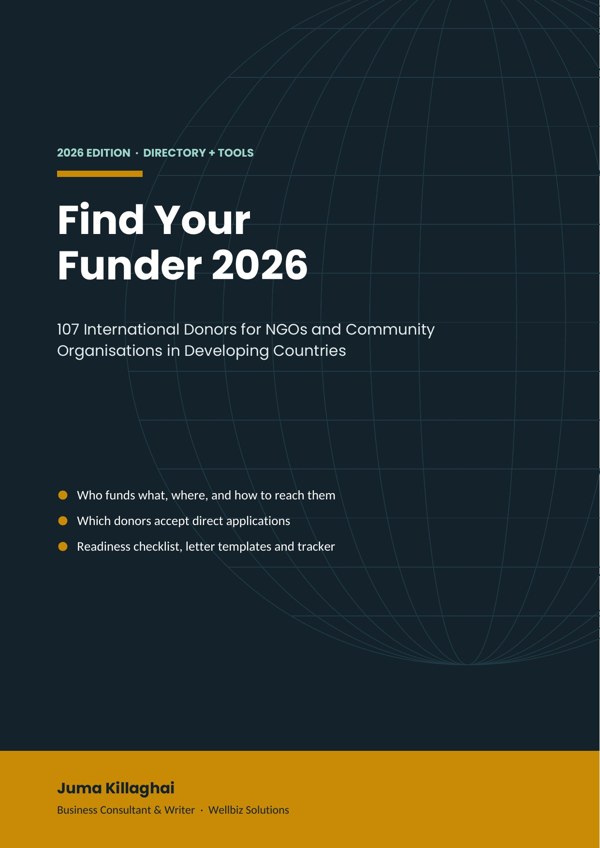
This article shows you ten funders. Find Your Funder 2026 gives you all 107 international funders plus 5 funding search portals, grouped by type, with what each one funds, the regions it covers, how a local organisation can reach it and its 2026 status, so you know who has cut budgets and who is still giving.
Also inside: a list of 33 funders you can approach directly, an index by theme (health, education, women, climate, livelihoods and more), a funder-readiness checklist, eight steps to approach a donor, an introduction email template, a concept note outline, a guide to spotting scams, and an Excel workbook with a filterable directory, an application tracker and a 12-month funding calendar.
How to get your copy:
- Click the Payhip link (or buy on Gumroad)
- Tap "Buy Now" and complete checkout
- Download the 28-page PDF and the Excel workbook instantly
It costs $12. One successful grant is worth hundreds of times more.
Prefer Kiswahili? Get the Kiswahili edition: Pata Mfadhili Wako 2026
Frequently Asked Questions
Is there still international funding for NGOs after the USAID cuts?
Yes. Official aid fell by about 23% in 2025, but the EU, Norway, Denmark, UN funds, embassy schemes, private foundations and African women's funds are still funding. The money is harder to win, so target donors that accept applications from local organisations.
Can a small CBO apply directly to international donors?
Some, yes. Embassy funds such as the Canada Fund for Local Initiatives and Japan's grassroots grants, the GEF Small Grants Programme, UNDEF and African women's funds accept applications from local groups. Many others fund only through intermediaries or by invitation.
What documents do donors ask for?
A registration certificate, constitution, board list, audited accounts for two or three years, a bank account in the organisation's name, a safeguarding policy and a short profile or annual report.
How can I tell if a grant offer is a scam?
Real donors never ask applicants to pay a fee. Be suspicious of grants you never applied for, emails from Gmail or misspelled domains, and pressure to act within hours. Always check the donor's official website yourself.
Final Word
The funding world has changed, but organisations that do good work and present it well are still being funded. Pick five donors that match your work, get your documents in order and approach them the right way. The money is still there. You just have to look in the right places.
Need help with registration, a proposal or a funding strategy? Wellbiz Solutions can help. Call or WhatsApp: +255 754 281 131 / +255 655 281 131
Know an NGO or community group looking for funding? Share this article with them.
Sources: US Government Accountability Office, GAO-26-108607 (2026); Norad, "Dramatic cuts in aid" (14 April 2026); Development Policy Centre, "The confederacy of cutters: OECD aid, 2023–2028" (May 2026); Government of the Netherlands, NGO funding announcement (11 November 2024); Chronicle of Philanthropy, "Gates Foundation Unveils $9 Billion Budget" (January 2026).
Join the conversation