10 Essential Elements of a Business Plan That Banks Take Seriously (with a Tanzanian Example)
Most business plans are turned down not because the idea is bad, but because the plan is vague, too optimistic or missing the numbers a lender needs. Here are the 10 elements that fix that.
If you don't know where you're going, it is very hard to reach the end of your journey. That is the main reason every business needs a business plan. A business plan is a clear, persuasive map of your business. It shows its quality and can convince lenders and investors to back you.
I first wrote this article in Kiswahili in 2019. Its points were originally inspired by Forbes' guidance on what makes a strong business plan. I have now updated it with my experience as a business consultant and the realities of doing business in Tanzania, including a worked example with numbers you can follow.
Throughout this article we will use Upendo Bakery, a fictional bakery that Grace plans to open in Sinza, Dar es Salaam, with a TSh 10 million bank loan. (It's a fictional example, but its numbers are built like a real business's.)

1. The Cover Page and Contents
The cover should carry the basics: business name, address, phone, WhatsApp and email, the names and contacts of all owners, and the date of the plan. The contents page should list every section with its page number.
The right length: for most bank loans, 15 to 25 pages plus appendices is enough. Large projects may reach 30 to 40 pages. A longer plan is not a better plan: most readers have little time.
2. The Executive Summary
This section carries everything important in your plan, briefly, usually in no more than two pages. Start with your value proposition: what your business does, how it will make money, and why customers will want to buy from you. If you are asking for money, state how much, how you will use it and how you will repay it.
You need the full picture of your business before you know what belongs in the summary. That's why the executive summary is written last, after every other section is finished, even though it appears first.
3. Market Opportunity
Describe clearly who your potential customers are, where they are, what they buy today and what they pay. Answer these questions: how big is your market? How fast is it growing? What opportunities and threats exist, and how will you handle them?
Don't say "everyone needs my product" or "I'll capture 1% of Tanzania". Estimate your market from the bottom up, showing each step:
| Upendo Bakery: market estimate | Figure |
|---|---|
| Households within 2 km of the bakery | 20,000 |
| Share that buy bread regularly (survey of 60 households) | 60% |
| Average loaves per household per week | 4 |
| Local bread market per day | about 6,860 |
| Grace's target (150 loaves a day) as a share of the market | about 2.2% |
Market information is available from sources such as the National Bureau of Statistics (NBS) and the 2022 Population and Housing Census, ward and street offices, sector regulators, TRA, business associations such as TCCIA, and your own customer research. Record your sources so you can back up your claims and improve your plan later.
4. Industry and Competitor Analysis
Don't make the mistake of thinking your business is unique. Analyse your competitors in depth: who are they? What do they sell, and at what price? How much of the market do they hold? Why will customers choose you over them? What barriers will you face entering the market?
Include indirect competitors too: businesses selling similar products in a different market today, or meeting the same need in another way. Tomorrow they may decide to enter yours. Finish with a short SWOT table (strengths, weaknesses, opportunities and threats).
5. Marketing and Sales Plan
This is the element many plans forget. A great product nobody hears about doesn't sell. Explain your prices and how you set them, your sales channels (shop, delivery, agents, WhatsApp, social media, institutional contracts), your promotion activities and their budget, and your monthly sales targets. Those targets must match the numbers in your financial plan.
6. The Management Team
Execution matters as much as the idea itself. That's why lenders and investors look closely at your team. Include a short profile of each key person covering the skills, qualifications, experience and achievements relevant to this business. If it's a partnership, explain why you chose your partners; if it's a company, show its structure. Name any skills gaps and how you will fill them. Put full CVs in the appendices.
7. The Operational Plan
This section explains how the business will work day to day: location and premises, equipment, the production or service process, operating hours and capacity, sources of revenue (product sales, services, fees) and operating costs (wages, rent, raw materials, maintenance). Name your key suppliers and distribution partners, and their backups.
Also state the key assumptions your plan depends on and why they are reasonable, and the licences and registrations you need: BRELA, a TIN from TRA, a business licence and any sector permits.
8. Financial Performance and Projections
If your business already operates, include at least the last 12 months of financial statements: an income statement, a balance sheet and a cash flow statement. For every plan, include projections for at least three years, a 12-month cash flow forecast and a break-even analysis.
| Upendo Bakery: key numbers | TSh |
|---|---|
| Monthly sales at full capacity | 14,820,000 |
| Monthly fixed costs (including the owner's salary) | 4,050,000 |
| Monthly loan repayment (TSh 10m, 24 months, 20% a year) | 508,958 |
| Monthly sales needed to cover all costs and the loan | 10,563,439 |
| Break-even as a share of full capacity | 71% |
Stress-test your projections. Don't wait for a crisis to learn how your business copes. Show three scenarios: best, base and worst case. For Upendo, if sales fall 30% while flour prices rise 10%, the bakery loses about TSh 874,000 a month, and its TSh 4 million reserve would last about four and a half months. Write down what you would do if that happened.
The big lesson: the bakery loses cash in its first three months while sales build up. Without a working capital reserve it would run out of money in its very first month, even though it covers all its costs from month four. That's why the cash flow forecast is the page banks read most carefully.
9. Sources and Uses of Funds

If you're asking for money, lenders and investors will want to know how you will use it and why. Show one table of sources and uses, with equal totals. Grace needs TSh 21,250,000 (TSh 17,250,000 of startup costs plus a TSh 4,000,000 reserve); she and her family contribute TSh 11,250,000, and she requests a TSh 10,000,000 loan.
Many entrepreneurs forget how high startup costs can be: rent and deposits, equipment, furniture, branding, licences and opening stock. Collect real quotations before you ask for funding.
10. Appendices
A good business plan shows the essentials quickly, but its evidence sits in the appendices: CVs of owners and managers, credit history, market research results, building and equipment drawings, copies of contracts, registration certificates, licences and title deeds, letters from prospective customers and agreements with business partners.
5 Mistakes That Sink Most Business Plans
- "We have no competitors." Every business has competitors or substitutes.
- Forgetting the owner's salary. It makes profit look higher than it is.
- No working capital reserve. The business runs out of cash before sales build up.
- Sales at 100% from day one. Show a realistic build-up.
- Numbers that don't match. Marketing targets, staff numbers and the financial plan must agree.
📘 Get the Complete Guide, with 9 Ready-to-Use Tools
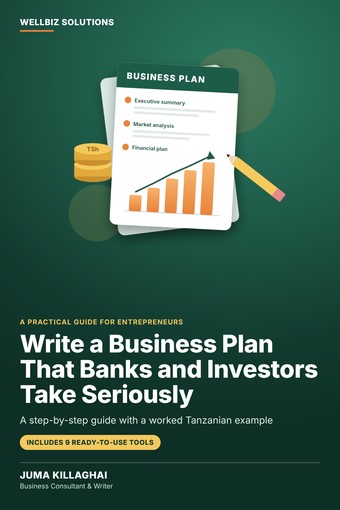
This article gives you the 10 elements. The kit Write a Business Plan That Banks and Investors Take Seriously walks you step by step to a finished plan: a 50-page illustrated guide with 16 chapters, the full Upendo Bakery example, the "five Cs" banks use to judge loans, and a 30-day plan to finish your business plan.
Plus 9 tools: a Business Plan Template with all 13 sections, a one-page business plan, a customer survey and market-size calculator, competitor and SWOT analysis, a marketing plan, team profiles, a risk register, a final review checklist, and an Excel Financial Planner with 7 linked sheets (startup costs, loan, 12-month cash flow, 3-year P&L, break-even and stress test).
How to get your copy:
- Click payhip.com/b/ed3NI
- Tap "Buy Now" and complete checkout
- Download the PDF guide, the 8 Word tools and the Excel planner instantly
It costs $15. One good plan can be the difference between a "no" and a "yes" from the bank.
Prefer Kiswahili? Get the Kiswahili edition: Andika Business Plan Inayoaminika na Benki na Wawekezaji
Planning to grow an existing business? The Business That Grows Businesses
Frequently Asked Questions
What is a business plan?
A written map that explains what your business does, for which customers, how it will compete, how it will operate, how much money it needs and how it will make a profit. It helps you test your idea, persuade lenders and investors, and guide your decisions after you open.
How many pages should a business plan be?
For most bank loans, about 15 to 25 pages plus appendices. A one-page plan is useful for testing an idea. Large projects may run to 30 or 40 pages.
What do banks look for in a business plan?
Most banks assess your character, the business's capacity to repay from its cash flow, your own capital, collateral, and conditions such as the market and how the money will be used. The 12-month cash flow forecast is read most carefully.
Which section of a business plan should be written last?
The executive summary. It appears first but is written last, once every other section is finished.
Where can I get a business plan template with financial projections?
The kit Write a Business Plan That Banks and Investors Take Seriously includes a 50-page guide, 8 editable Word tools and an Excel Financial Planner. It is available on Payhip in English and Kiswahili.
Final Word
Your business plan doesn't have to be perfect. It has to be honest, clear and finished. Start one section today, and within a month you can have a plan you present with confidence.
Need help writing or reviewing your business plan? Wellbiz Solutions prepares business plans for loans, investors, tenders and investment registration. Call or WhatsApp: +255 754 281 131 / +255 655 281 131
Found this helpful? Share it with an entrepreneur who is preparing to apply for a loan.
Join the conversation