Same Shop, Ten Years Later: Why Your Small Business Isn't Growing (and How to Fix It)
You open early, close late and serve every customer yourself. So why is your business still the same size it was years ago? Hard work isn't the problem. These 6 hidden barriers are.
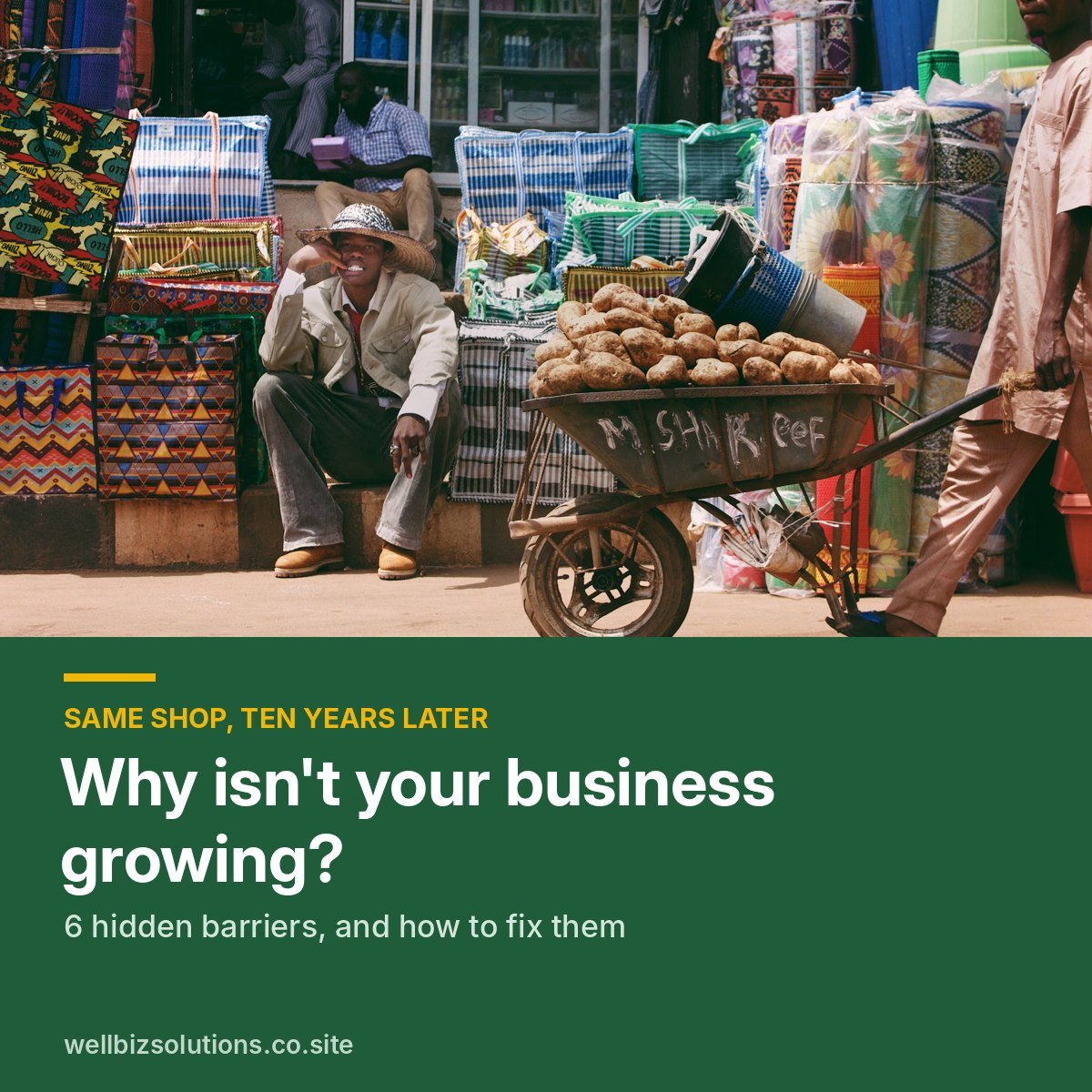
Walk down any busy street in Dar es Salaam, Arusha or Mwanza. You'll see shops, small restaurants, salons, pharmacies and workshops. Behind each one is someone who took a brave step and decided to work for themselves.
Now come back to the same street ten years later. Very often you'll find the same shop, in the same place, with the same owner behind the counter. There's more stock. Maybe a second fridge. But the one shop never gave birth to a second, a third or a fourth.
Mama Neema knows this feeling. She opened her retail shop in Mbagala nine years ago. It sells well. Customers love her. Yet she still opens it every morning and closes it every night, and if she falls ill for a week, the shop closes too. (Mama Neema is a fictional example, but her story will sound familiar to thousands of business owners.)
If that sounds like you, the good news is this: the reasons your business isn't growing are predictable, and most of them are within your control.
First, What Does "Growth" Really Mean?
A fuller shop is not the same as a growing business. Real growth shows up in four places at once:
- Revenue: sales rise year after year, not only because prices went up.
- Profit: what's left after all costs, including your own salary, increases.
- Systems: work follows written procedures that someone else can follow.
- Owner freedom: the business can run for a week without you, without falling apart.
The fourth measure is the one most owners forget, and the most important. A business that can't run without you can't give birth to another business, because you can't be in two places at once.
The 6 Hidden Barriers That Keep Small Businesses Stuck
Most small businesses aren't held back by one big problem. They're held back by six smaller ones that reinforce each other. Score yourself as you read: 0 (not true of me), 1 (somewhat true) or 2 (very true).
1. You are the business
You open, sell, buy stock, hold the money and close. Every decision waits for you. This creates an invisible ceiling: the business can never be bigger than the hours in your day. Warning sign: if you're away for three days, sales drop or the shop closes.
2. Business money and household money are mixed
When everything sits in one pocket, cash in hand feels like profit, even when it's really the money for your next stock purchase. Warning sign: you don't know for certain what last month's profit was.
3. Your records live in your head
Without written numbers, decisions are made on feeling. You might believe your most popular product is your most profitable one, when rising supplier prices have quietly erased its margin. Warning sign: you can't name, with figures, your three most profitable products.
4. There's no system anyone else can copy
A second branch isn't a second building. It's the system of the first one, repeated somewhere else. If nothing is written down, there's nothing to repeat. Warning sign: nothing is written about how your business works.
5. No one has been trained to take over
Many owners were once hurt by a dishonest employee and decided, "I'll just do it myself." It's understandable, but it locks the business into barrier 1 for ever. Warning sign: no one can do your three most important tasks without you.
6. There's no written goal
Without a clear destination, every day is like yesterday, and profit is spent on whatever emergency appears. Warning sign: you can't say in one sentence where your business will be in three years.
Your score: 0 to 3 means your foundation is strong. 4 to 7 means a few specific areas need work. 8 to 12 means: build the foundation before you think about expanding. Start with the one barrier that scored highest.
The Money Fix: Pay Yourself a Salary
This single habit changes more small businesses than any loan. Look at Mama Neema's typical month:
| Item | TSh |
|---|---|
| Monthly sales | 6,000,000 |
| Cost of goods sold | 4,800,000 |
| Rent, power, assistant's wages, licences | 550,000 |
| Profit before the owner's salary | 650,000 |
| What she actually takes home each month | 900,000 |
Mama Neema takes home TSh 250,000 more than her shop earns, every single month. That money comes straight out of her capital. That's why the shop looks busy while the stock keeps shrinking and her debts to suppliers keep growing.
The fix is simple, though not easy:
- Open a business-only account or mobile money number. All sales go in; all business costs go out from there.
- Pay yourself a fixed salary on the same day every month, no more than about 60 to 70% of your usual profit.
- Split what remains: 30% emergency reserve, 50% more working capital, 20% expansion fund.
- Close your books every month: sales, real profit, and whether your capital went up or down.
Are You Ready to Open a Second Branch? Three Questions You Can't Skip
Many owners kill a good business by expanding too early. Before you sign a lease on a second location, you must be able to answer "Yes" to all three of these:
- Has my business made a real profit for at least 12 months in a row?
- Has it run without me for at least a week, with no drop in sales?
- Do I have the start-up money plus six months of running costs, without putting the first business at risk?
If any answer is "No", don't expand yet. A new branch rarely makes a profit in its first months, and if your first shop still depends on you, splitting your time can bring down both.
6 Smart Ways to Grow (A Branch Is Only One of Them)
| Growth route | Capital | Risk |
|---|---|---|
| 1. Sell more to the customers you already have | Low | Low |
| 2. Sell beyond your location (WhatsApp orders, delivery) | Low to medium | Low |
| 3. Add value to what you sell | Medium | Medium |
| 4. Sell wholesale, or to offices and schools | Medium | Medium |
| 5. Open a branch | High | High |
| 6. Partnership or brand licence | Low to medium | Medium |
Routes 1 to 4 can start this month, and they build the profit and savings that pay for a branch later. When Mama Neema noticed customers kept asking for cooking gas and phone airtime, she simply added both. No new premises, no loan, but more sales from every customer who walked in.
Your First Step This Week
Ask ten of your regular customers one question: "What else would you like to be able to buy here?" Write down the answers. That's where your first growth opportunity is hiding. Then take one sheet of paper and write your sales for the last three months, your main monthly costs, and the five tasks you do yourself every day. If you don't know some of the numbers, write "I don't know". That's useful information too.
📘 Get the Complete Guide, with 14 Ready-to-Use Tools
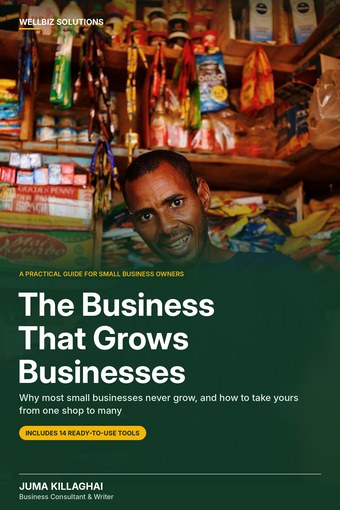
This article shows you the barriers and the first steps. The e-book The Business That Grows Businesses walks you through the whole journey, from a business that depends on you to one that can grow: 9 practical chapters with Tanzanian examples, the full 10-question readiness test, 6 growth routes explained, and a 90-day action plan.
Plus 14 ready-to-use tools: 4 Excel calculators (real profit, owner's salary and profit split, profit per product, new branch cost) and 10 editable Word forms, including a daily sales and cash handover form, stock count form, opening and closing checklist, work procedure template, handover checklist and new location survey.
How to get your copy:
- Click payhip.com/b/VIgv4
- Tap "Buy Now" and complete checkout
- Download the illustrated PDF, the 4 Excel calculators and the 10 Word tools instantly
It costs $15, less than a day's profit for most shops. Use it to build the business that keeps paying you for years.
👉 Get the e-book and the 14 tools
Prefer Kiswahili? Get the Kiswahili edition: Biashara Inayozaa Biashara
Ready to build your team? Hire Right the First Time and Good Employees Don't Leave for Nothing
Frequently Asked Questions
Why is my small business not growing even though I work hard?
Usually because the business is built around you. When the owner sells, buys, cooks and holds all the money, the business can never be bigger than the owner's working hours. Mixed money, records kept in the head, no written systems, no trained staff and no written goal are the other common barriers.
How much salary should a small business owner pay themselves?
A fixed amount, paid on the same day every month, that is no more than about 60 to 70% of the business's usual profit before your salary. Split what remains between an emergency reserve, more working capital and an expansion fund.
When is a small business ready to open a second branch?
When it has made a real profit for at least 12 months in a row, has run without the owner for at least a week with no drop in sales, and the owner has the start-up money plus six months of running costs without putting the first business at risk.
Can I grow my business without opening a branch?
Yes. Sell more to existing customers, sell beyond your location by phone or delivery, add value to what you sell, or sell wholesale to other businesses and institutions. These routes need less capital and carry less risk than a new branch.
Is there a practical guide to growing a small business in East Africa?
The e-book The Business That Grows Businesses by Juma Killaghai includes Tanzanian examples, a 90-day action plan, 4 Excel calculators and 10 editable Word tools. It is available on Payhip in English and in Kiswahili.
Final Word
Your business wasn't started to stay the same size for ever. It was started by someone brave enough to begin. Point that same courage at building: separate your money, write down one system, train one person. A business that grows businesses isn't born in a day. It's built week by week.
Want help planning your business's growth? Call or WhatsApp us: +255 754 281 131 / +255 655 281 131
Found this helpful? Share it with a business owner who has been running the same shop for years.
Join the conversation