Stop Hiring by Chance: 7 Hiring Mistakes and a 7-Step Process to Hire Right the First Time
The CV looked perfect. The interview was friendly. Four months later, the damage was done. Here's why hiring goes wrong, what it really costs, and a simple process any employer can follow

Mr Hamisi runs a growing hardware and building-supplies business in Mwanza. His accountant had just left, the year-end was coming, and he needed someone fast.
A cousin recommended a young man with a good accounting degree. The certificates were impressive. The interview was short and friendly: they talked about family, football and the young man's plans. Mr Hamisi liked him. He started the following Monday.
Four months later, supplier invoices had been paid twice. Stock records didn't match the shelves. A tax return had gone in late, with a penalty. Two of his best shop staff complained that the new accountant was rude, and one of them was already looking for another job.
When Mr Hamisi finally let him go, he asked the question every employer asks too late: "How did I not see this coming?"
The honest answer: he never looked. He hired on certificates, a family recommendation and a pleasant conversation. None of those tell you whether someone can actually do the job, or how they'll behave once they have it. (Mr Hamisi is a fictional example, but his story will sound familiar to many employers.)
What One Bad Hire Really Costs
Mr Hamisi paid his accountant TSh 900,000 a month. He stayed five months. Here's what that one decision really cost:
| Cost | Details | TSh |
|---|---|---|
| Recruitment | Adverts and interview time | 250,000 |
| Wasted salary | 5 months' pay at about 40% useful output | 2,700,000 |
| Errors and penalties | Double payments, late-filing penalty, stock losses | 1,800,000 |
| Supervisor time | The owner checking and correcting the work | 500,000 |
| Lost customers | A key contractor moved his account | 1,200,000 |
| Hiring again | A second recruitment round | 350,000 |
| Total | 6,800,000 |
One bad hire cost TSh 6.8 million, more than seven months of the accountant's salary. The hiring itself cost only TSh 250,000. Spending a little more care at that stage would have saved millions.
This matches wider research: Gallup estimates that replacing an employee costs between half and twice their annual salary. A bad hire often costs more, because you pay twice: once for the wrong person, and again to find the right one.
The 7 Traps Behind Most Bad Hires
Hiring mistakes are rarely bad luck. They follow the same patterns again and again:
- Hiring the certificate, not the person. A degree shows someone passed exams. It doesn't show they can do this job, with your customers.
- Hiring relatives and friends without a fair test. A trusted recommendation is valuable. Skipping the normal checks because of the relationship is not.
- Hiring in a rush. "We need someone by Monday" is the most common route to a bad hire. The weeks you save are lost many times over.
- The pleasant-chat interview. Being good at interviews isn't the same as being good at work. Without structured questions, you're judging charm, not ability.
- Not knowing exactly what you need. If you can't write down the five most important tasks of the job, you can't judge who can do them.
- Overselling the job. Promise faster promotion or easier hours than the job really offers, and the new hire leaves as soon as they discover the truth.
- Skipping references. Two phone calls take 30 minutes. It's one of the most powerful steps in hiring, and the one most often skipped.
Every one of these traps is within your control. You don't need a big budget or an HR department, just a clear process, used the same way every time.
The 7-Step Process to Hire Right the First Time
Step 1: Define the job before you advertise
Answer five questions on one page: Why does this job exist? What are its five most important tasks? What does "doing it well" look like after six months? Who will this person work with? What makes the job hard? Then separate must-haves (the person can't do the job without them) from nice-to-haves (helpful, but they can be learned). Keep the must-haves to four or five.
Step 2: Write an honest advert
A good advert attracts the people you want and discourages the ones you don't. Say what the person will do, why someone would want to work for you, what you need, and what's hard about the job ("Saturdays and busy month-ends"). Add one small instruction, such as "In your message, tell us in three sentences about a time you handled an angry customer." Applicants who ignore it have shown you how they follow instructions. Ask your best staff for referrals too: good people tend to know good people.
Step 3: Screen fairly, then make a 15-minute call
Screen every CV against the same must-haves: Yes, Maybe or No. Then phone the strongest candidates. Fifteen minutes is enough to confirm they understand the job, can work the hours and location, and that their salary expectation is within your range. It saves hours of interviews with people who could never accept.
Step 4: Interview about the past, not the hypothetical
The most useful rule in interviewing is this: the best predictor of future behaviour is past behaviour. Instead of asking what someone would do, ask what they did. Ask every candidate the same questions, and score each answer straight after the interview, before you talk to the next person. (See the 10 questions below.)
Step 5: Test the work before you pay for it
An interview tells you how someone talks about their work. A short practical test shows you how they actually do it:
| Role | Test idea |
|---|---|
| Sales / retail | A role-play: you are a customer with a problem or objection |
| Office / admin | Organise a set of documents, draft a short letter or email |
| Accounts | Reconcile a short bank statement with a few errors hidden in it |
| Teacher | A 15 to 20-minute demonstration lesson |
| Technician / driver | A supervised real task: diagnose a fault, or a short supervised drive |
Keep it short (15 to 60 minutes), fair (the same task and instructions for everyone), supervised, and marked against a guide you wrote before the test.
Step 6: Call at least two references
Former direct supervisors are the most valuable references: they watched the candidate work day after day. Ask for specific examples, not general opinions. And always ask the most important question: "Would you employ this person again if you had the chance?" A quick "Yes, definitely" is very different from "Well… yes, I suppose so." Verify key certificates too, especially for roles involving money, children or safety.
Step 7: Make the offer, and close well
Call your chosen candidate first, then confirm in writing the same day: job title, salary, start date, hours and probation period. Give every employee a written contract. Use the probation period actively, with clear goals and regular feedback. And send a short, respectful reply to every candidate you interviewed but didn't choose. People talk, and today's rejected candidate may be tomorrow's customer.
10 Interview Questions That Reveal the Truth
These behavioural questions work for almost any role. Choose a few, ask every candidate the same ones, and listen for real names, numbers and details:
- Tell me about a time you made a mistake at work. What did you do about it?
- Tell me about a time someone asked you to do something you felt was wrong. What did you do?
- Tell me about a time you were given more money, change or stock than you should have. What happened?
- Describe a time you had to tell your boss bad news. How did you do it?
- Tell me about the hardest working week you've had. How did you manage it?
- Tell me about a time you disagreed with a colleague. How did it end?
- Tell me about a time you received criticism you didn't agree with. What did you do?
- Tell me about something new you had to learn quickly for work. How did you learn it?
- Why are you leaving (or why did you leave) your last job?
- What would your last supervisor say is the one thing you need to improve?
The first answer is always polished. The truth comes in the follow-ups: "What exactly did you do?", "What happened in the end?" and "Looking back, what would you do differently?" Good candidates reflect honestly. Weak ones blame others.
Running a Small Business? Here's the Lean Version
You don't need every step at full size, but you need the principles more than anyone, because one bad hire can damage a small business badly. Write down the five key tasks (30 minutes). Ask trusted staff and customers for referrals (1 hour). Make a 10-minute call to the best five or six (1 hour). Interview the best two or three with a few behavioural questions and a short practical task (2 to 3 hours). Call two references and put the offer in writing (1 hour).
That's about six hours of your time, for a decision that will affect your business for years. Two rules never change: never skip the practical test, and never skip the reference calls, especially for anyone who will handle cash or stock. And treat relatives exactly like everyone else: same questions, same test, same standard.
Fair hiring is also the law. Tanzanian employment law prohibits discrimination in employment, including during recruitment, on grounds such as sex, pregnancy, marital status, religion, tribe, race, disability or HIV status. Don't ask about plans to marry or have children, and never require an HIV test. Judge people on their ability, behaviour and fit for the job: it's fairer, and it works better. (This article is practical guidance, not legal advice.)
Mr Hamisi's Second Chance
When Mr Hamisi had to hire an accountant again, he did it differently. He wrote down what the job really required. He was honest in the advert about the busy month-ends. He phoned the best six applicants, interviewed four with the same questions, and gave the best three a short test: a bank statement and a cash book, with four errors hidden inside.
A quiet young woman with a diploma, not a degree, found all four errors in twenty minutes. Her former supervisor said without hesitation: "I would hire her again tomorrow." Two years later, supplier payments are never duplicated, and the tax returns go in on time.
The difference wasn't luck. It was a process.
📘 Get the Complete Hiring Kit, with 14 Ready-to-Use Tools
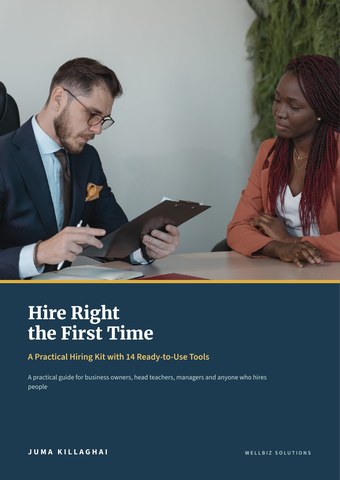
This article gives you the process. The kit Hire Right the First Time gives you everything you need to use it on your next vacancy: 9 practical chapters with Tanzanian examples, a lean process for small businesses and a 30-day hiring plan.
Plus 14 tools as editable Word files: job description template, job scorecard, job advert template with 3 examples, CV screening sheet, phone screening script, interview scorecard, red flags checklist, practical test guide, reference check form, offer letter, rejection letter and a hiring checklist. Also included: a bank of 130 interview questions for 8 common roles and an Excel cost-of-a-bad-hire calculator.
How to get your copy:
- Click payhip.com/b/fjw2d
- Tap "Buy Now" and complete checkout
- Download the 79-page PDF, the 14 Word tools and the Excel calculator instantly
It costs $15. Compare that with the millions of shillings one wrong hire can cost you. It may be the cheapest hiring decision you make this year.
👉 Get the hiring kit and the 14 tools
Prefer Kiswahili? Get the Kiswahili edition: Usiajiri kwa Kubahatisha
Once you've hired the right person, keep them: Good Employees Don't Leave for Nothing
Frequently Asked Questions
How much does a bad hire cost?
Much more than the salary. Once you add wasted pay, errors, supervisor time, lost customers and the cost of hiring again, one bad hire often costs more than half a year's salary. Gallup estimates that replacing an employee costs between half and twice their annual salary.
What are behavioural interview questions?
Behavioural questions ask candidates to describe real situations from their past work, for example: "Tell me about a time you made a mistake at work. What did you do about it?" They work because the best predictor of future behaviour is past behaviour.
How many references should I check before hiring?
At least two, ideally former direct supervisors. The most revealing question is: "Would you employ this person again if you had the chance?" Listen carefully to any hesitation.
Can a small business follow a proper hiring process?
Yes. A lean version (define the job, find candidates, a short phone screen, a structured interview with a practical test, and two reference calls) takes about six hours of the owner's time.
Where can I get ready-made hiring templates and interview questions?
The hiring kit Hire Right the First Time by Juma Killaghai includes 14 editable Word tools, a bank of 130 interview questions for 8 common roles and an Excel cost-of-a-bad-hire calculator. It is available on Payhip for $15, in English and in Kiswahili.
Final Word
Good hiring isn't about finding a perfect person. It's about collecting enough evidence, in a fair and consistent way, to make a good decision before you sign the contract. Start with your next vacancy: write down the job, ask about the past, test the work, and call the references. Stop hiring by chance.
Need help with recruitment, interview questions or manager training? Call or WhatsApp us: +255 754 281 131 / +255 655 281 131
Found this helpful? Share it with a business owner or manager who is about to hire.
Source: Gallup, "This Fixable Problem Costs U.S. Businesses $1 Trillion" (gallup.com/workplace).
Join the conversation