Unemployed Graduate? How to Earn Your First Income in 30 Days
There is a message that goes round social media every few months. It says that if you graduated more than a year ago and still have no job, it is time to hang up your degree and start using your head, because in life nobody cares how many degrees you have, only how much money you have.
If you are an unemployed graduate, you have probably seen it. It is half right, and the half that is wrong can hurt you.
What the message gets right
If you have spent a year sending applications with no result, repeating the same method for another year is a poor plan. Universities release far more graduates each year than the formal economy has jobs for. That is arithmetic, not a judgment on you. When a hundred qualified people apply for three positions, ninety-seven qualified people go home.
It is also true that education can become an obstacle. This happens when it turns into pride: "I have a degree, I cannot be seen doing that work." Meanwhile someone with less schooling starts that same small business and grows it.
What it gets wrong
"Hang up your degree" is bad advice. Your degree is proof that you can learn difficult things, finish long work, write clearly and handle numbers. Small businesses around you need exactly those abilities. Your classmates are now spread across companies and towns, and a customer often trusts a graduate more easily.
A degree is not a ticket to a job. It is a tool, and a tool only helps the person who picks it up and uses it.
So the useful advice is this: do not wait for your degree to rescue you, and do not throw it away. Start something small and use your education to do it better.
A realistic 30-day plan for an unemployed graduate
You do not need a loan or a big idea. You need four steps, one week each.
Week 1: List what you already have
Write four lists: what your studies taught you to do, what you can do outside your studies, who you know, and what tools you can use. A smartphone is already a camera, a shop and an office. Look for the places where a skill of yours meets a person who needs it.
Week 2: Choose one idea and make an offer
Pick an idea that passes three tests:
- People near you already pay for it.
- You can start with what you have.
- You can be paid within 30 days.
Tutoring, CV writing, bookkeeping for small shops, poster design, managing a local business's social media page and reselling through WhatsApp all pass these tests for many graduates. These are business ideas with little or no capital, because the customer pays before or as you deliver.
Then write your offer in one sentence: "I help [who] to [result] for [price]."
Week 3: Tell 30 people
Most graduates skip this step. Send a personal message to thirty people you know, one by one, with a sample of your work. Visit five businesses in person. Ask those who cannot buy who they know that might.
Week 4: Serve your first customer well
Deliver on time and slightly better than you promised. Collect your payment, write it down, and ask for a short recommendation. That first payment may be small, but it proves that you can create income and not only apply for it.
| Week | Focus | Result by the end of the week |
|---|---|---|
| 1 | Audit and choose | One idea chosen, written on one page |
| 2 | Build the offer | A clear offer with a price and one sample |
| 3 | Tell people | Thirty conversations, at least one serious lead |
| 4 | Deliver and collect | Work delivered, money received, one recommendation |
What about finding a job?
Keep looking, but give it two focused hours a week and not your whole day. The work you start will also strengthen your CV. "Self-employed, bookkeeping for four retail shops" reads far better to an employer than a two-year gap, and your customers often hear about vacancies before they are advertised.
Get the full 30-day workbook
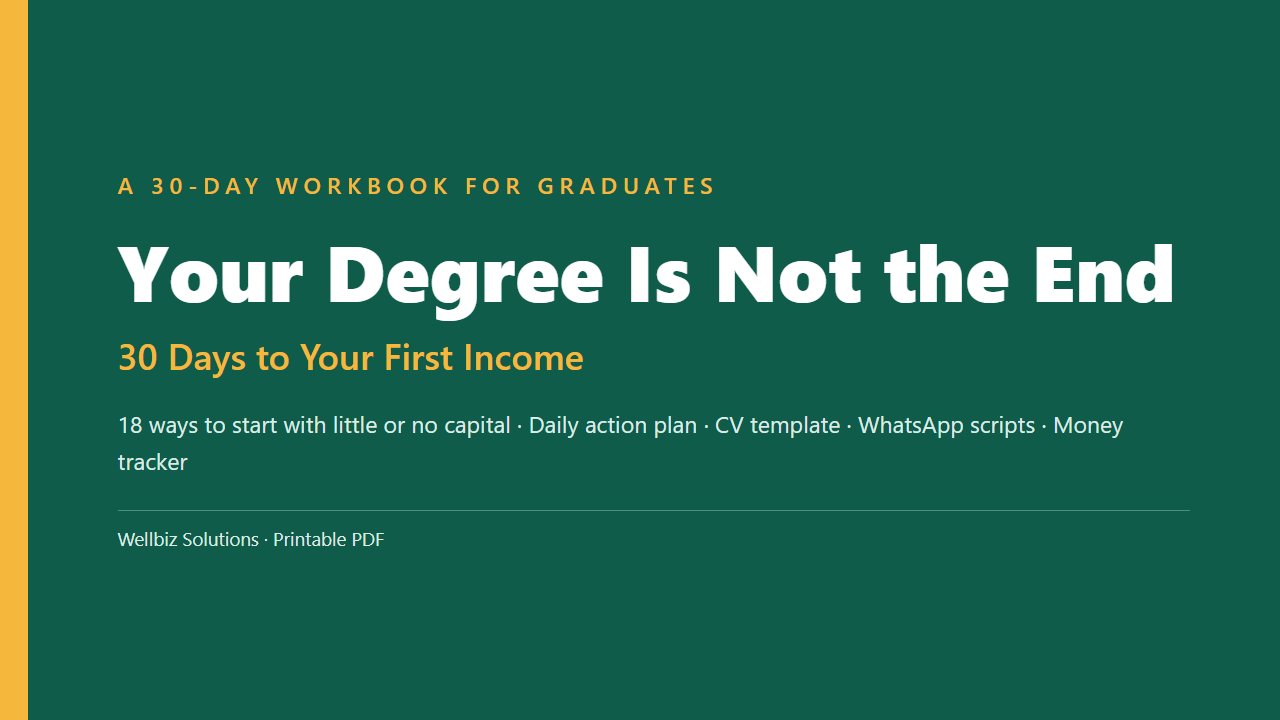
We have turned this plan into a printable workbook: Your Degree Is Not the End: 30 Days to Your First Income. It includes:
- Worksheets for your four lists and for scoring your ideas
- Eighteen ways to start with little or no capital, each with first steps and the mistake to avoid
- One task for each of the 30 days
- A one-page CV template, six WhatsApp messages for finding customers, and an income and expense tracker
Get Your Degree Is Not the End - $3
Also available on Gumroad.
Prefer Swahili? Soma makala kwa Kiswahili and get the Swahili edition, "Shahada Yako Si Mwisho".
Frequently asked questions
What should I do if I graduated and cannot find a job?
Keep applying, but limit it to two focused hours a week, and use the rest of your time to start one small income activity with the skills, contacts and tools you already have. List what you have, choose one idea people already pay for, tell 30 people, and serve your first customer well.
Is my degree useless if I cannot get a job?
No. A degree is not a ticket to a job, but it is a tool. It proves you can learn difficult things, finish long work, write clearly and handle numbers, and those abilities make you better at any business you start.
What business can a graduate start with little or no capital?
Ideas that many graduates can start with what they already have include tutoring, CV and application writing, bookkeeping for small shops, poster design, managing a local business's social media page, and reselling through WhatsApp by taking orders before buying stock.
Will self-employment hurt my chances of getting a job later?
It usually helps. Self-employed work shows initiative and responsibility and reads far better on a CV than a long gap after graduation. Customers also hear about vacancies before they are advertised.
Keep reading
- The power of micro-businesses - ideas to increase your income
- The 30-Day Money Reset - what to do with the money once it starts coming in
- Why your salary runs out before month-end: a 5-step personal finance plan
This article is general guidance and not a promise of income. Results depend on the work you put in.
Join the conversation