Colonel Sanders Started KFC at 65: Why It's Never Too Late to Succeed (and 5 Lessons You Can Use)
He left school at 12, was fired from job after job, and at 65 had little more than a $105 pension cheque and a chicken recipe. What he did next built one of the world's best-known brands.
"I'm too old to start now." I hear this often from people in their forties, fifties and sixties: employees who feel stuck, people facing retirement, and retirees sitting on a pension lump sum and wondering what to do next.
If that sounds like you, the story of Harland "Colonel" Sanders, the founder of Kentucky Fried Chicken (KFC), is worth your time. He lived from 1890 to 1980, had very little formal education, failed again and again, and only found real success when most people are thinking of slowing down.
A Hard Start: School Ends at 12
Sanders was born in Indiana, USA. His father died when he was five, so he cooked for his younger brother and sister while his mother worked. He dropped out of school at 12 and, at 13, left home to escape a harsh stepfather.
Instead of drifting into trouble, as many runaway boys might, he looked for work. He laboured on farms, painted horse carriages and, in 1906, became a conductor on the streetcars (trams) of New Albany, Indiana. That same year, aged 16, he lied about his age and joined the US Army. He served about four months in Cuba before being honourably discharged.
Thirty Years of Jobs, Firings and Failures
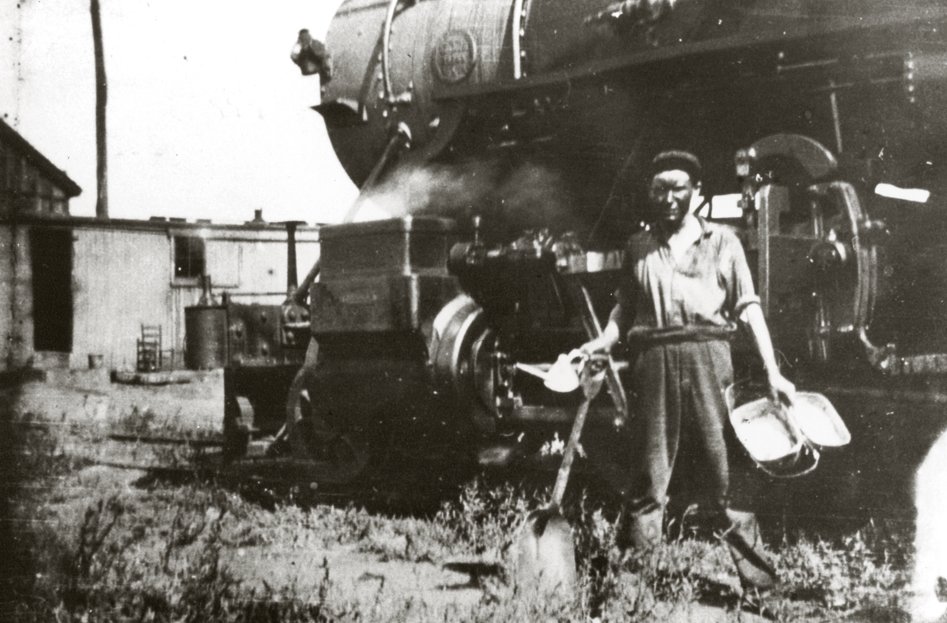
After the army, Sanders found work on the railways. At 16 he became a fireman, the man who shovels coal into a steam engine's firebox (not a firefighter, as the word is sometimes misread). He lost that job after a dispute, then took labouring work with the Norfolk and Western Railway.
While still working on the railways, he studied law by correspondence through La Salle Extension University. He practised law in Little Rock for about three years, until a courtroom fight with his own client ruined his reputation. He went back to labouring on the Pennsylvania Railroad.
The list goes on:
| Year | What happened |
|---|---|
| 1916 | Sold life insurance for Prudential; fired for insubordination. Moved to Louisville to sell insurance again for Mutual Benefit Life. |
| 1920 | Raised money from investors to start an Ohio River ferry company between Jeffersonville and Louisville; became its secretary and a minority shareholder. |
| Early 1920s | Cashed in his ferry shares for $22,000 and started a company making acetylene lamps. It failed when Delco began selling electric lamps on credit. |
| 1924 | Lost his job selling Michelin tyres when the factory closed. By chance, the same year, Standard Oil of Kentucky gave him a filling station to run in Nicholasville. |
| 1930 | The Great Depression closed the Nicholasville station. |
He was now 40, with a long record of jobs that had ended badly. His biographer John Ed Pearce put it bluntly: his repeated failures came largely from stubbornness, impatience and a lack of self-control.
The Turning Point: Chicken at a Filling Station
Also in 1930, Shell Oil offered Sanders a filling station in Corbin, Kentucky, rent-free in return for a percentage of sales. He began cooking chicken, country ham and steaks for hungry travellers. With no restaurant, he served them in his own living quarters next to the pumps.
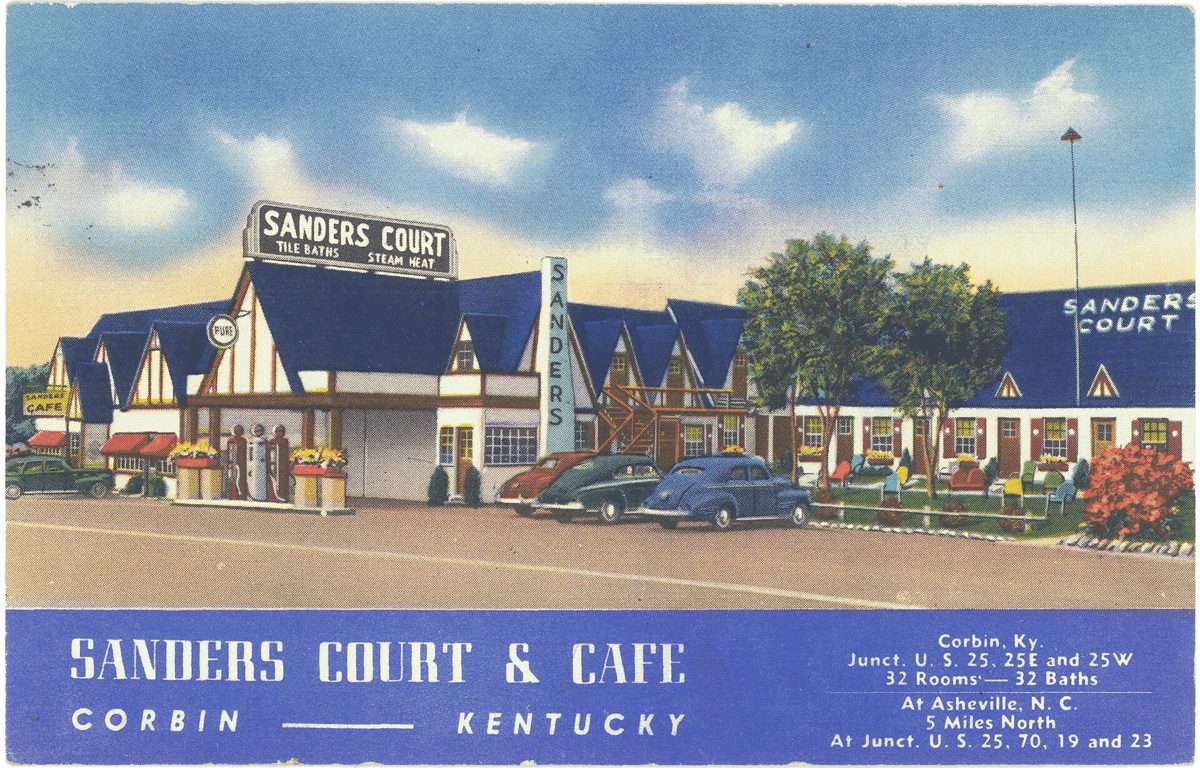
The food became popular. In 1935 the Governor of Kentucky, Ruby Laffoon, gave him the honorary title of Kentucky Colonel. (It is an honour, not a military rank.) By 1940, aged 50, he had perfected his "secret recipe" of herbs and spices and a way of cooking chicken quickly in a pressure fryer.
In 1952 he sold the right to use his recipe to Pete Harman, who ran one of the largest restaurants in Salt Lake City, Utah. It was Harman's sign painter who came up with the name "Kentucky Fried Chicken". In the first year, Harman's sales more than tripled, and 75% of the increase came from the chicken.
Broke at 65, and Starting Again
Then disaster struck again. In the mid-1950s a new highway, Interstate 75, bypassed Corbin. The traffic that fed his restaurant disappeared. At 65 he sold the business and was left with his savings and a government pension of $105 a month.
Most people would have retired. Sanders packed his pressure cooker and spice mix into his car and drove from town to town. He cooked his chicken for restaurant owners and their staff. If they liked it, they signed a deal to sell it and paid him a few cents for every chicken sold. He often slept in the back of his car. His wife Claudia mixed and shipped the spices.
About the "1,009 rejections" story: you may have read that Sanders was turned down 1,009 times before his first yes. No reliable record supports that number, and his first deal came through his friendship with Harman. What is documented is less dramatic and more useful: years on the road, one restaurant at a time.
From 600 Outlets to a Global Brand
The franchise model worked. By the mid-1960s KFC had more than 600 outlets and had reached Canada, the UK, Mexico and Jamaica. The growth became too much for the ageing founder.
In 1964, aged 73, he sold the Kentucky Fried Chicken company for $2 million to investors led by John Y. Brown Jr., a 29-year-old lawyer, and Jack Massey. He kept his Canadian business, and the new owners paid him a salary to be the face of the brand. In 1965 he moved to Mississauga, near Toronto, to run his Canadian franchises.
He kept working, travelling and appearing in his famous white suit until shortly before his death in 1980, aged 90. By then there were about 6,000 KFC outlets in 48 countries. Today KFC has more than 30,000 restaurants around the world.
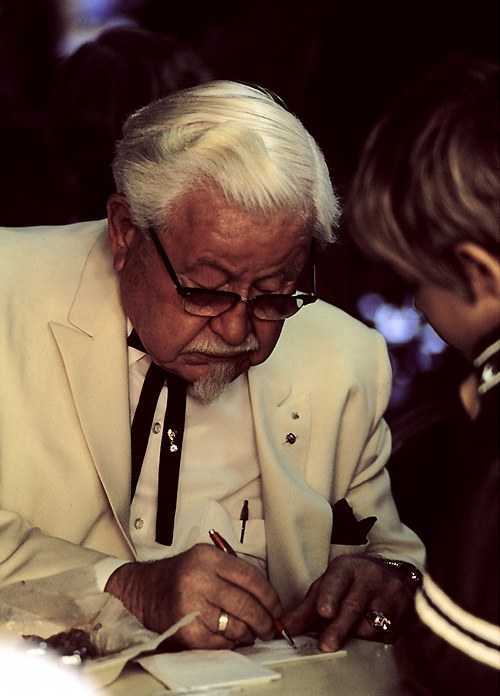
The numbers that matter for you: he opened his roadside café at 40, perfected his recipe at 50, sold his first franchise at 62, started franchising full-time at 65 and sold the company at 73.
5 Lessons for Anyone Starting a Business After 40

- Build on what you already have. Sanders didn't learn a new trade at 65. He sold 25 years of cooking skill and a salesman's experience. Your next business should grow from your own skills, knowledge and network, not from someone else's success story.
- Test before you invest. One restaurant proved his idea before he took it on the road. Before you spend your gratuity or pension lump sum, prove that real customers will pay for a small version of your idea.
- Sell face to face. He didn't wait for customers; he cooked in front of them. When you're small, a demonstration beats advertising, and your network is your biggest marketing asset.
- Build a system that doesn't depend on your body. Others cooked and sold his chicken, so the business grew as he aged. Write down how you work, train someone early, and look for ways others can sell for you.
- Protect your savings. Sanders didn't borrow to build 600 restaurants; franchisees used their own premises. Late-life founders have less time to recover from a big loss. Keep safety money aside, and put business money in stages.
And one honest lesson from his weaknesses: Sanders lost many jobs to his temper. Patience and good relationships are business skills too.
📘 Starting Late? Get the Step-by-Step Kit
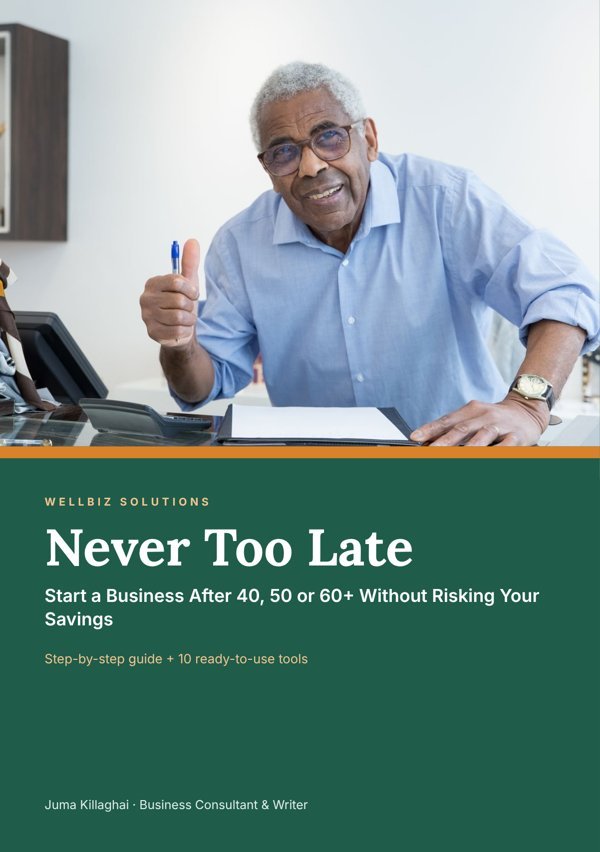
This article gives you the inspiration. The kit Never Too Late: Start a Business After 40, 50 or 60+ Without Risking Your Savings gives you the method: a 30-page illustrated guide that walks you through 10 steps, from mapping what you already have to a 90-day launch plan, with three Tanzanian examples you can follow.
Plus 10 tools: an Asset Map, a Business Idea Scorecard, a 30-day "Test Before You Invest" plan, a Protect-Your-Savings plan (the Three-Bucket Rule), a family conversation guide, a one-page business plan, a First 50 Customers list, a 90-day launch planner, a weekly energy check, and an Excel planner that works out your buckets, idea scores, start-up costs, prices and break-even.
How to get your copy:
- Click the Payhip link (or buy on Gumroad)
- Tap "Buy Now" and complete checkout
- Download the guide, 9 Word tools and the Excel planner instantly
It costs $15. Testing first can save you far more than that.
Prefer Kiswahili? Get the Kiswahili edition: Hujachelewa
Frequently Asked Questions
How old was Colonel Sanders when he started KFC?
He began selling chicken at his filling station around age 40, perfected the recipe at 50, sold his first franchise at 62 and began franchising full-time at about 65.
Was Colonel Sanders really rejected 1,009 times?
No reliable record supports that number. What is documented is that he travelled for years, often sleeping in his car, selling to restaurant owners one by one.
How much did Colonel Sanders sell KFC for?
$2 million in 1964, to investors led by John Y. Brown Jr. and Jack Massey. He stayed on as the brand's paid ambassador and kept his Canadian business.
Is it too late to start a business at 50 or 60?
No. Older founders bring experience, networks and trust. The key is to build on skills you already have, test small, protect your savings and build a business that doesn't depend on you every day.
Final Word
Colonel Sanders didn't succeed because he was lucky or young. He succeeded because he used what he knew, proved it worked, sold it face to face and kept going. Success may be waiting for you too. Just try, wisely.
Thinking of starting a business after retirement or a job loss? Wellbiz Solutions helps with business ideas, registration and business plans. Call or WhatsApp: +255 754 281 131 / +255 655 281 131
Found this inspiring? Share it with someone who thinks it's too late.
Sources: Wikipedia, "Colonel Sanders" (drawing on Sanders' autobiography and biographies by John Ed Pearce and Josh Ozersky); Nation's Restaurant News, "KFC surpasses 30K restaurants globally" (March 2024).
Join the conversation